A proposed law that will give terminally ill, mentally competent adults the option to control the manner and timing of their death.
The Terminally Ill Adults (End of Life) Bill
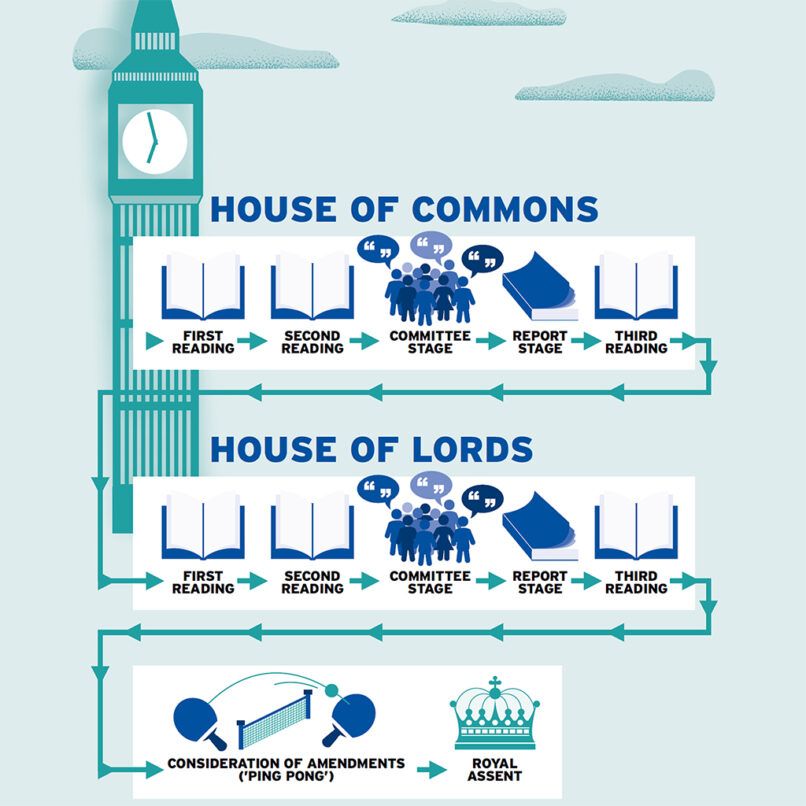
The Terminally Ill Adults (End of Life) Bill, if passed, would have legalised the choice of assisted dying for terminally ill, mentally competent adults. First introduced by Kim Leadbeater MP in 2024, the bill completed all its steps in the House of Commons after more than 100 hours of scrutiny by MPs and was amended in consultation with government legal advisers to ensure it is safe and workable.
On Friday 20 June 2025, a majority of MPs voted for the bill to progress to the House of Lords, with 314 voting in favour and 291 voting against. See how your MP voted on parliament’s website.
On Friday 19 September 2025, the bill received its Second Reading in the House of Lords. After an unprecedented level of amendments were tabled by a small number of Peers, the bill ran out of time in the House of Lords and could not pass by the end of the session in May 2026.
In June 2026, Lauren Edwards MP reintroduced the bill.
On Friday 11 September 2026, MPs voted down the reintroduced bill at its Second Reading. 270 MPs voted in favour of the bill, and 286 against. See how your MP voted on parliament’s website.
What the assisted dying bill propsed
The bill propsed that adults who are terminally ill, mentally competent, and have 6 months to live or less should have the option to choose assisted dying. It also includes a number of safety measures:
Eligibility: The bill offers choice only to terminally ill adults with mental capacity if they are expected to die within six months. The bill specifically excludes people with disabilities or mental illness alone if they are not terminally ill. Mental capacity is required throughout the process, to be assessed by medical, legal and social care professionals on at least five occasions
Protections: All requests must be made on the basis of a clear, settled and informed decision by the person concerned. All the options available, including palliative care and pain relief, must be discussed. The dying person’s decision must be confirmed at every stage and they can change their mind at any time.
Medical supervision: Two doctors must independently confirm that the person meets the eligibility criteria and has made a voluntary decision, free from coercion. An independent specialist must be consulted if there is any doubt about the person’s mental capacity or if the doctor lacks expertise in the terminal illness concerned. No medical practitioner will be under any obligation to engage with the process.
Expert oversight: A multidisciplinary panel consisting of a senior lawyer, psychiatrist and social worker oversee the process. They must hear from and may question the individual, at least one of the doctors, and any other person in order to reach their decision, which must be unanimous;
Periods of reflection: There must be at least seven days between the two medical assessments and a further 14 days after the decision by the expert panel.
Safety: Strict protocols will ensure the safe prescribing, transportation and administration of all medication. The process must be overseen by a trained medical practitioner who will be expressly forbidden from taking any action to end the person’s life. The medication must be self-administered and if it is not used it must be removed immediately.
Monitoring: The application of the law will be very closely monitored with details of every assisted death collected and published annually. The operation of the law and the availability of palliative care will be reviewed regularly with Parliament given the opportunity to scrutinise its impact.
New offences: The bill creates new offences making it illegal by dishonesty, coercion or pressure to induce a person to make a declaration requesting assistance or to self-administer a medication. Falsifying, destroying or concealing documentation would also be against the law.
Assisted dying bill process
The Terminally Ill Adults (End of Life) Bill is a Private Member’s bill. Private Members’ bills are draft laws, proposed by individual members rather than the government. They are selected by a ballot at the start of each session of Parliament.
The Terminally Ill Adults (End of Life) Bill is the most recent in a number of attempts to change the Law.
Baroness Meacher’s Assisted Dying Bill (2021)
This Bill was proposed to the House of Lords by Baroness Meacher May 2021. Baroness Meacher is a past Chair of Dignity in Dying and life peer in the House of Lords.
What the Bill proposed
The Bill proposed to legalise assisted dying as a choice for terminally ill, mentally competent adults with six months to live or less. The person’s choice would have to be approved by two independent doctors and a high court judge. A prescription for life-ending medication would then be granted for the person to take when and where they were ready.
The process and outcome
The Bill had its first reading on 26 May 2021. It was first debated at its second reading on 22 October 2021. It passed this stage unopposed with a majority of speakers in favour and strong cross party support, including several people who changed their position on the issue.
The Bill then passed to Committee Stage but ran out of time and was unable to pass all the necessary stages before the parliamentary session ended. The bill officially failed when the new session began, marked by the Queen’s Speech in May 2022.
Labour MP Rob Marris introduced an Assisted Dying Bill to the House of Commons in 2015. It was based on Lord Falconer’s 2014 Bill.
What the Bill proposed
The Bill proposed to allow terminally ill, mentally competent adults to have an assisted death after being approved by two doctors.
The process and outcome
The Bill was defeated at its Second Reading in 2015 after four hours of debate. This was the first ever debate on an assisted dying law in the House of Commons and the first vote on the principle since 1997.
This Bill was proposed to the House of Lords by Lord Falconer in June 2013 but was not allocated time for debate. It was then reintroduced in June 2014 and debated for the first time in July 2014.
What the Bill proposed
The Bill proposed to allow terminally ill, mentally competent adults to have an assisted death after being approved by two doctors. It was based on the Oregon Death with Dignity Act, which has allowed assisted dying in that State since 1997. Find out more about assisted dying in Oregon.
The process and outcome
The Bill was debated and passed at second reading in the House of Lords in July 2014. Over 120 Peers took part in the almost 10-hour-long debate. Further debates took place in November 2014, when an amendment proposed by Lord Pannick added judicial oversight to the assisted dying process, a proposal that was agreed unanimously in the House of Lords.
In January 2015 two opposition amendments to derail the Bill were defeated by large margins. Due to a lack of time with the impending General Election in May 2015, no further progress was made on the Bill.
We’re close to winning a new assisted dying law – but we may need to take further campaign actions together. Can we email you updates and vital actions?