MPs backing return of assisted dying bill outnumber opponents 2:1, in first Commons debate since minority of Peers talked it out
The Government must act to ensure democracy is respected on assisted dying, MPs across the political spectrum declared this evening (Monday 8 June 2026), in defiance of the deliberate obstruction of the Terminally Ill Adults (End of Life) Bill by a handful of unelected Lords. MPs were debating the topic for the first time since the Bill’s historic Third Reading vote in favour last June, after which it ran out of time to complete its stages before the end of the last parliamentary session due to what is widely accepted as a filibuster by a minority of Peers.
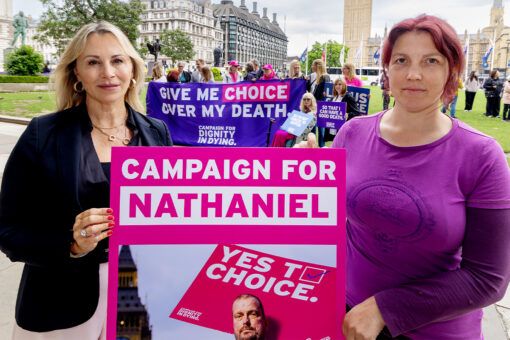
The debate was triggered by a petition of over 114,000 signatures, tabled by terminally ill campaigner Sophie Blake in memory of Nathaniel Dye MBE, who died in January 2026. Nat was a 40-year-old music teacher, Labour activist, and tireless cancer awareness campaigner who devoted the final months of his life to fighting for the law change he never lived to see.
The mood in the chamber was clear and cross-party, with speeches and interventions in favour of the Bill returning and progressing to a democratic conclusion outnumbering opponents by two to one.
Sarah Wootton, Chief Executive of Dignity in Dying, said:
“Tonight belongs to Nat, to Sophie, and to every dying person who has refused to be silenced. They petitioned, they marched and they repeatedly gave evidence of their own suffering so that Parliament could not look away. They have brought MPs and the public with them, and they are determined not to allow the actions of a few unelected Peers to prevail.
“Every week change is delayed, people are dying without the choice and protection they want and need. MPs tonight made clear they agree: the Bill must come back, the Government must act and the will of the Commons must be respected. For many, this is a matter of life and death. But it’s also about democracy. That affects us all.”
Labour MP Simon Opher, a GP who sat on the Bill Committee and now co-chairs an All Party Parliamentary Group on Lords Reform , declared that “the public expects Parliament to debate, scrutinise and improve legislation, not to allow a small unelected minority to prevent the will of the elected house being carried into law.” Conservative MP Andrew Mitchell said the treatment of the Bill in the House of Lords had had “a belittling effect” on Parliament, and that the answer was Government time to allow a new bill to be thoroughly debated and reach a democratic conclusion. Lewis Atkinson MP (Labour), who led the debate, put the democratic case plainly: “We can’t only believe in parliamentary democracy when it suits us.” Green MP Sian Berry agreed: “Where the House of Commons has the courage to come to a decision, it is not for the House of Lords to stop it using these kinds of methods.” Peter Bedford MP (Conservative) corrected media claims that he had softened his supportive stance. Responding for the Government, Minister Alan Campbell MP said he was sure debate on assisted dying would continue, and confirmed that all Public Bills including Private Members’ Bills would fall within the scope of the Parliament Acts; a significant acknowledgement that should the Bill return and be supported by MPs again, the Lords cannot block it a second time.
The Terminally Ill Adults (End of Life) Bill passed the House of Commons last June with a clear majority, following more than 100 hours of scrutiny. A small number of unelected Peers responded by tabling the majority of more than 1,200 amendments, in what is widely recognised as a deliberate attempt to stall progress and prevent conclusive votes from taking place. Two hundred Lords wrote to MPs on the day of the final debate to criticise the filibuster and encourage MPs to bring back the Bill, while 150 MPs wrote directly to the Prime Minister calling for his intervention to grant more time for the Bill to complete its stages.
The petition was carried to Parliament by Sophie Blake, who is herself living with incurable secondary breast cancer. Sophie took up Nat’s fight after his death, driving the petition past 114,000 signatures. Earlier today, she stood in Parliament Square alongside terminally ill people, bereaved families and MPs, not as a symbol, but as a person who knows exactly what is at stake.
Sophie Blake said:
“I did this for Nat. I did it for every person who is dying right now without the choice this Bill would give them. Tonight MPs heard from the public loud and clear: we want this Bill back. I’m living with incurable cancer. I don’t have the luxury of waiting for the next session, or the one after that. Neither do thousands of people like me. The elected House has already spoken, the public have spoken, now it is time for the Government to act to ensure the Bill gets the time it needs.”
Over 150 MPs have written to the Prime Minister demanding guaranteed parliamentary time for the Bill. An All-Party Parliamentary Group on Lords Reform has been established in direct response to the Lords’ obstruction. The Private Members’ Bill ballot, which took place last month, presents an immediate opportunity for a high-drawn MP to bring a bill back before Parliament, with cross-party appetite to support it stronger than ever, as shown in tonight’s debate. Should the Lords engage constructively this time, meaningful progress is possible. Should they attempt to obstruct the will of the Commons again, tonight’s confirmation from the Government that the Bill would fall within the scope of the Parliament Acts means the elected chamber’s decision cannot be overridden.
*ENDS*
*For more information and requests, please contact Tom Steen, Media and Campaigns Officer at tom.steen@dignityindying.org.uk or call 07356135578