“This is for every family fighting for choice” — Esther Rantzen and Prue Leith named in Women in Westminster 100 as assisted dying Bill faces delay
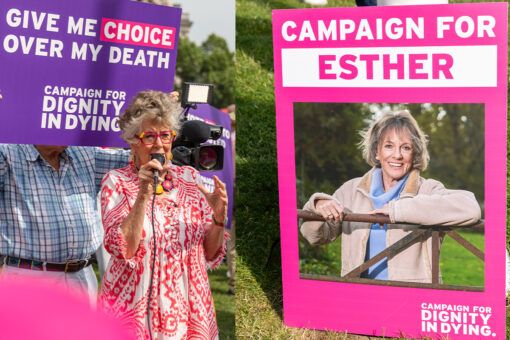
Dignity in Dying today congratulates Dame Esther Rantzen DBE and Dame Prue Leith DBE on their inclusion in the 2026 Women in Westminster: The 100 list, which celebrates the most influential women shaping public policy and political life in Britain.
Both women have used their public platforms with extraordinary courage to campaign for the right of terminally ill people to choose the manner and timing of their death. But in responding to today’s honour, their message is unequivocal: this recognition belongs not only to them, but to the thousands of families across the country who have driven this movement from the ground up. Those who have stood on Parliament Square in the rain, watched from the public gallery, written letters, spoken to the media, and shared the most painful experiences of their lives to make the case for change.
Dame Esther Rantzen said:
“I’m extremely grateful for this Award, it is humbling to be included among so many extraordinary women. I would like to pay a personal tribute to Dame Prue Leith, who has not only made cake-baking and spectacle-wearing stylish and fashionable but she has added her invaluable support to the cause of assisted dying,
And Dame Prue and I have been joined by some remarkable brave and eloquent supporters campaigning for assisted dying to be made legal for terminally ill patients who need this crucial choice if their lives have become unbearable. I have heard so many heartbreaking stories. I would like to thank and pay tribute to the friends, families, parliamentarians and health care professionals who have shared their experiences, their grief, their most private pain, and have done so in the hope that no one else will have to face the end without dignity or choice. This honour belongs to them. It is their courage and determination that has enabled us to reach this historic moment, and the best reward for them will be for Parliament to reform the current cruel messy criminal law, and for democracy to prevail. For terminally ill patients like myself, the best hope is for us to achieve a swift pain free death, knowing that we leave those we love with happy memories”.
Yet as their achievements are recognised, the Terminally Ill Adults (End of Life) Bill, which has already passed the House of Commons, faces intense delay in the House of Lords. The Bill was approved by MPs on a free vote after more than 100 hours of debate, during which parliamentarians considered detailed evidence, safeguards and amendments. In total, the legislation has now been subject to 200 hours of debate across both Houses, making it one of the most scrutinised Bills in recent history.
However, an unprecedented 1,200 amendments have been tabled to the Bill in the Lords, with over half put forward by just seven Peers, less than 1% of the House, all with longstanding opposition. While scrutiny is a vital part of the legislative process, there is growing recognition among parliamentarians and experts that many of these amendments do not seek to improve the Bill but instead appear designed to delay progress and run down the clock so the Bill cannot pass. Examples include amendments that would require terminally ill people to take pregnancy tests regardless of age or sex, or proposals that could deny someone access to assisted dying based on unrelated financial investigations involving family members.
The pressure for change extends well beyond Westminster. In February, the Senedd in Wales voted to allow assisted dying services to be delivered through the Welsh NHS and Jersey’s States Assembly passed its assisted dying law, the second parliament in the UK to do so, following the Isle of Man, whose Bill has been awaiting Royal Assent for nearly a year. Across the UK and its Crown Dependencies, the direction of travel is unmistakeable. Westminster is increasingly the outlier and the public knows it – the latest survey by the National Centre for Social Research (NatCen) also from last month, found that 79% of respondents felt assisted dying should be allowed. This figure has remained stable for decades, even with over a year of parliamentary scrutiny on the Bill.
Dame Prue Leith said:
“Being named on this list is humbling, but it means nothing if this Bill is allowed to fall in the Lords due to obvious obstruction. The public has not looked away. MPs and Peers on all sides of this debate feel the same deep outrage at what is happening. The eyes of this country remain fixed on the ultimate goal, democracy being upheld, an end to this cruel status quo, and the introduction of a safe, compassionate law that this country can be proud of”.
Sarah Wootton, CEO of Dignity in Dying said:
“We can’t thank enough Dame Esther, Dame Prue, and all of those people who choose to selflessly tell their most difficult realities time and time again in the advancement of compassionate choice at the end of life. These formidable women have used their platforms not only to share their own painful experiences but to champion the voices of families up and down the country, from all walks of life. They are all being recognised today for standing up for democracy and helping bring us closer than ever to a safe, compassionate assisted dying law this country can be proud of. As indefatigable campaigners, I know Dame Esther, Dame Prue will continue standing shoulder to shoulder with other terminally ill people and bereaved loved ones until this ultimate goal is achieved.”
*For more information please contact Tom Steen, Media & Campaigns Officer, tom.steen@dignityindying.org.uk or 07356135578*